Frame
Understand the business context and define the real problem before designing anything.
I translated ten marketing services, eleven specialist agents, and a human approval model into one clear customer and operations experience.
My role
UX/UI Designer and AI Product Manager
Focus
Strategy, systems, workflows, and visual direction

10
Service experiences brought into one system
11
Named AI specialists with clear responsibilities
300
Customer capacity used as the design target
100%
Human approval required before delivery
These figures describe the designed scope and operating target, not measured performance results.
One business problem became one clear customer journey and one governed AI service system.
Small business owners need marketing help, but the experience is fragmented, overwhelming, and hard to trust.
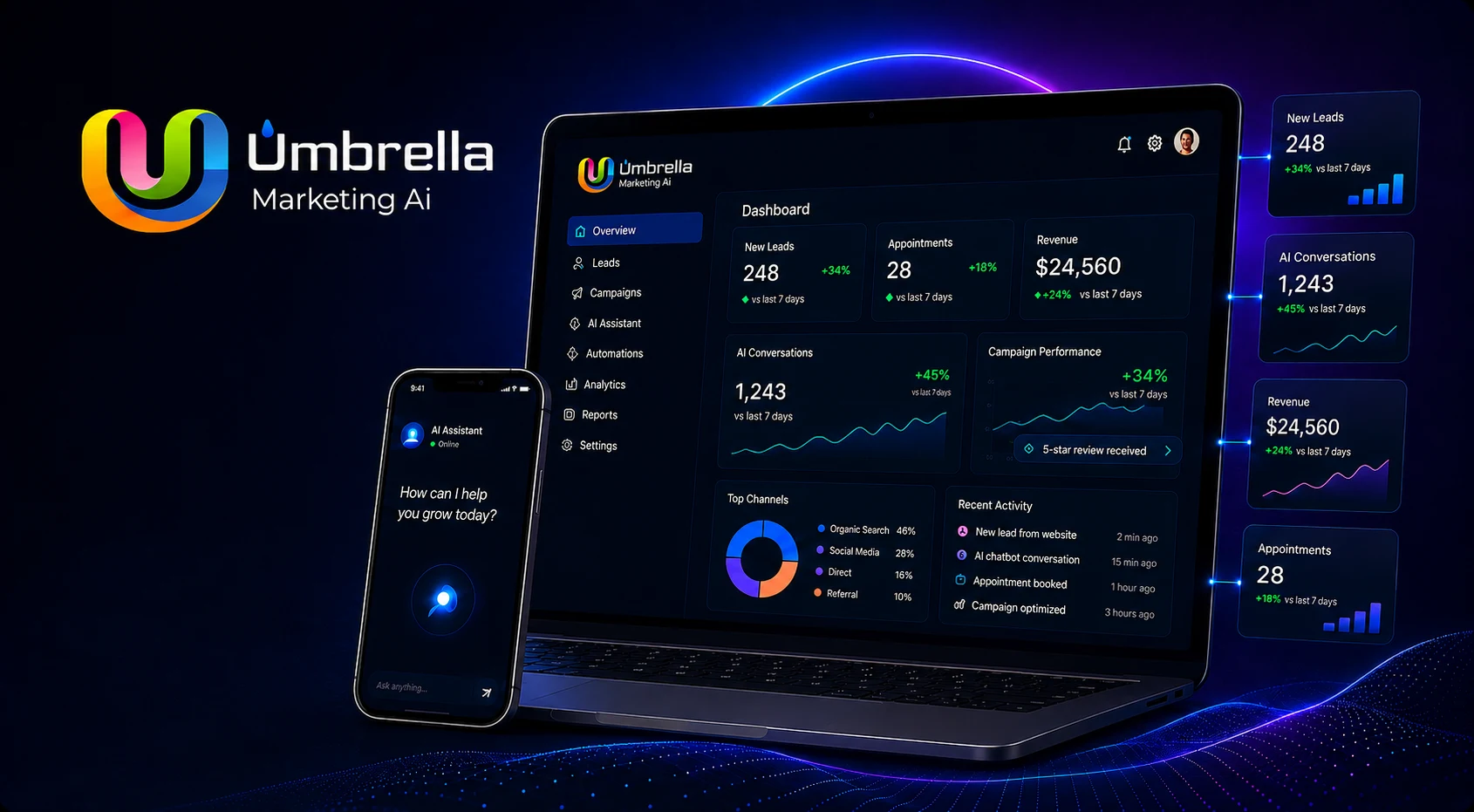
Before Umbrella, a small business owner faced ten different marketing services with no clear way to compare them or understand what they would actually receive.
The challenge
Small business owners need marketing support but face fragmented vendors, unclear packages, slow coordination, and little time to manage specialists.
The design response
Create one trustworthy front door, make services easy to compare, use Andy to guide decisions, and connect every request to a specialist AI workflow with human review.
The opportunity was not another marketing website. It was one understandable front door connected to a reliable operating model.
How Monica worked as UX/UI Designer and AI Product Manager to connect the customer experience with a reliable operating model.
Monica's dual role connected customer experience with operational feasibility. Every service page was designed with the downstream workflow in mind, and every public promise was checked against fulfillment capacity.
Each phase informed the others. Customer facing decisions looped back into operational constraints and vice versa.
Understand the business context and define the real problem before designing anything.
Organize ten services into one clear, comparable structure a visitor can scan.
Shape the visual system and the responsive experience across every screen.
Connect every request to a human governed AI workflow that can actually deliver.
Review, refine, and ship versioned improvements as the product matures.
The process repeats as the product matures.
Design and operations were never separate. Monica held both roles so the public promise always matched what the team could deliver.
Meet the growth stretched small business owner and the four moments that decide whether they stay or leave.
Runs a small business and wears many roles
Goals
Attract customers, understand what is working, save time, get reliable help
Behaviors
Researches on mobile, compares options, asks specific questions, values proof and fast response
Frustrations
Fragmented vendors, jargon, uncertain value, limited time, fear of losing control
Needs
Clear packages, confidence, visible progress, simple approvals, a human accountable for final quality
Proto persona based on business context and market assumptions, not interview research.
Research notes
A working hypothesis based on business context and stakeholder synthesis, designed for moderated validation.
Journey moment 1
Find marketing help online and compare the options
Curious, then overwhelmed
The friction: Too many options, unclear credibility, similar sounding packages
The design response: Clear navigation, value proposition, and service comparison
Journey moment 2
Ask questions, narrow the options, and pick a service
Relieved, then focused
The friction: Fear of being sold too fast, unclear deliverables and timeline
The design response: Guided recommendations and clear outcomes, without pressure
Journey moment 3
Describe the needs and watch the work move forward
Hopeful, then anxious
The friction: Complicated forms, vague briefing, no visibility into progress
The design response: Simple briefs with clear goals and status visibility
Journey moment 4
Review the work, accept it, and request more
Satisfied, then loyal
The friction: Poor quality without a revision path, no easy repeat path
The design response: Human review gate and a clear revision loop
The owner does not need more marketing choices. The owner needs clarity, trust, and visible control.
Chapter 04 · The customer journey
Ten complex marketing services became one understandable journey with three repeatable acts.
A clear homepage explains the value, groups ten services into a system, and gives owners a simple place to begin.
Design outcome
The visitor understands the offer before being asked to choose.
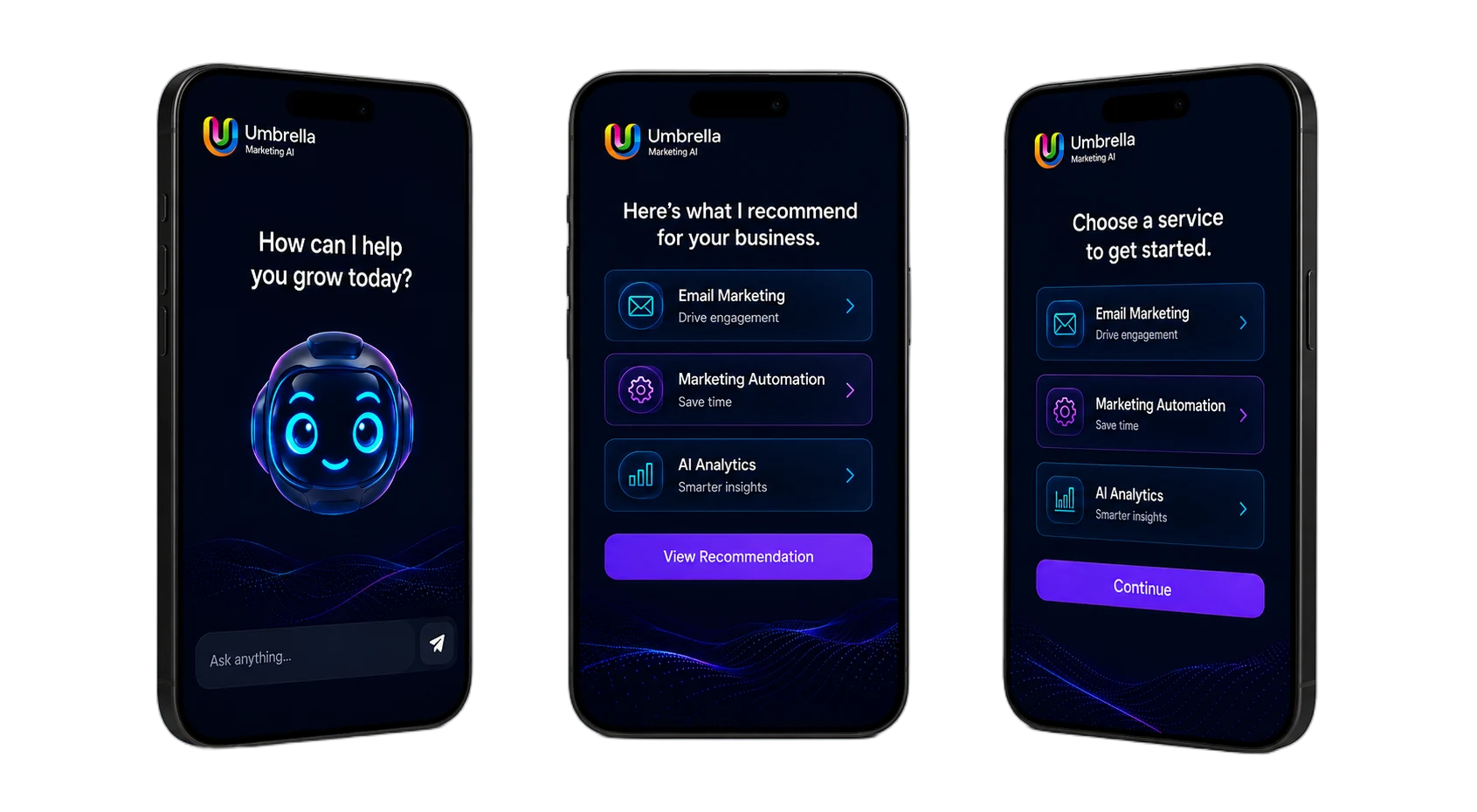
Andy asks about the business goal, recommends the most relevant service, and explains why it fits.
Design outcome
Guidance replaces a long catalog and reduces decision pressure.
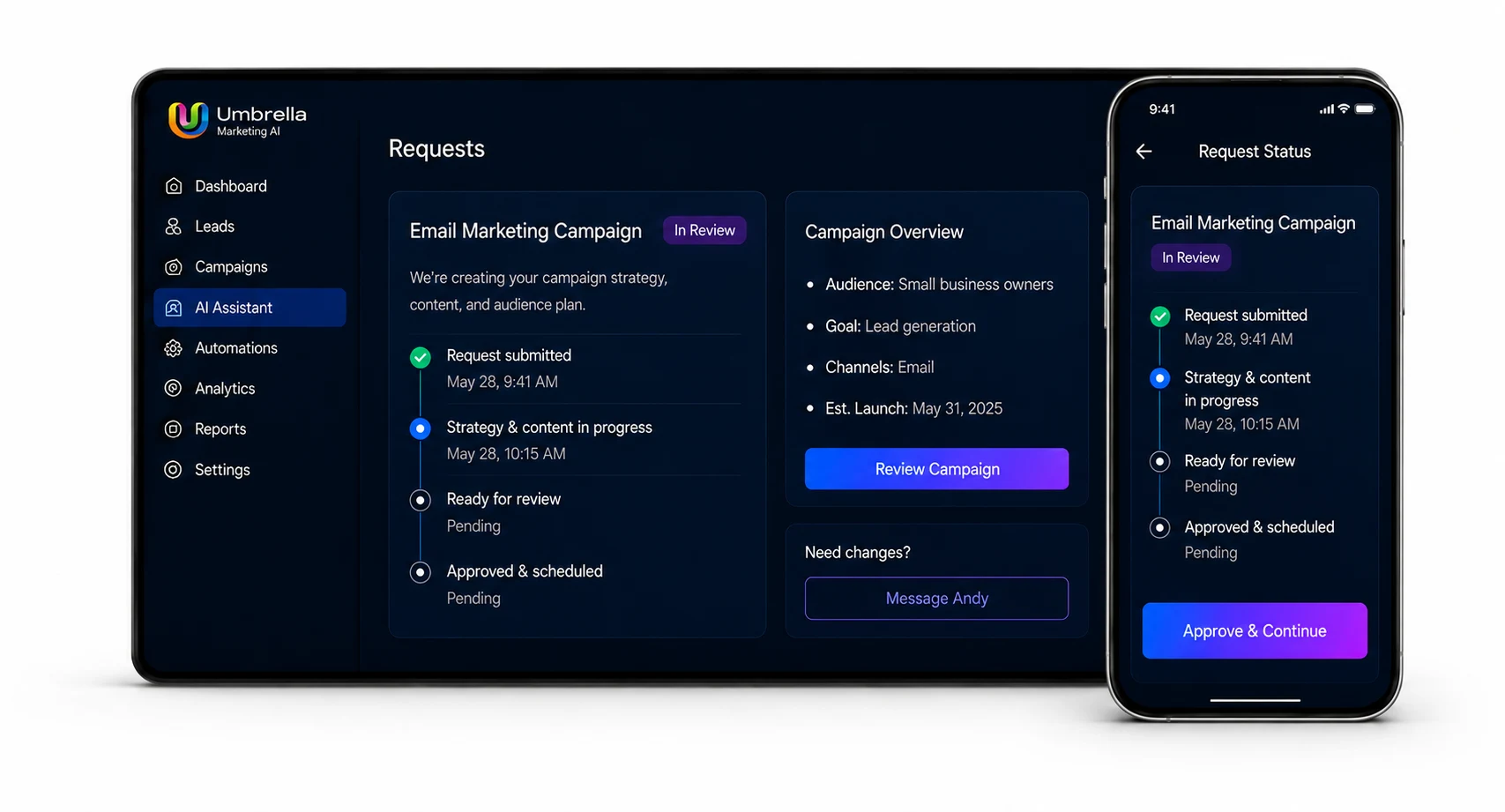
The portal keeps the brief, progress, review, requested changes, and final approval in one visible workflow.
Design outcome
Customers stay informed while every deliverable remains human reviewed.
One journey, two coordinated layers
Customer sees
Clear choices, request status, review controls, and a direct path to approval.
Umbrella coordinates
The right specialist, a human owner, production steps, and delivery governance.
A simple customer experience on the surface. A controlled, human governed operating system behind it.
The orchestration model
Andy helps a visitor describe the goal and understand the right next step. Behind the conversation, the request is routed to the specialist designed for that service.
AI accelerates the first draft. Monica and the team remain responsible for facts, brand voice, promises, approval, and final delivery.
 Ask Andy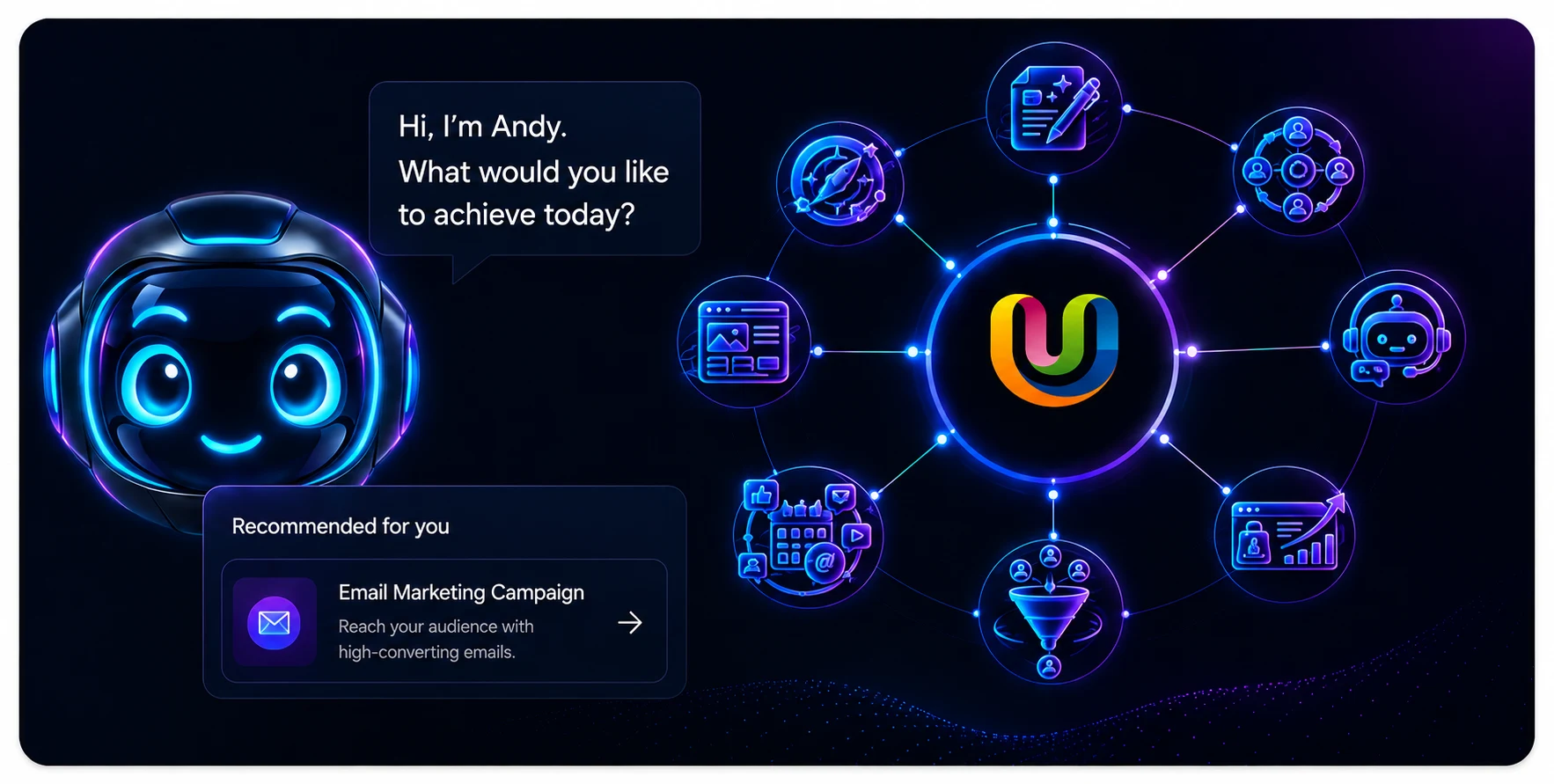
Frontstage
A short guided conversation that turns uncertainty into a confident service choice.
Andy clarifies and recommends. He never creates a request or commits the visitor without their action.
Backstage
The specialist prepares a first draft. A human checks facts, links, voice, and promises before approving delivery.
Specialist AI
Generates the first draft
Human review
Checks and approves the work
Delivery
Releases the approved result
Purpose built AI team
Consistent inputs, one controlled draft, one visible human approval gate, and a clearly defined deliverable.
Growth Strategy
Business context and growth goal
Structure priorities and a first strategy draft
Validate assumptions, scope, and recommendations
Deliverable
Growth roadmap
Lead Generation
Audience, offer, and funnel goal
Draft funnel sequence and lead assets
Check claims, links, and conversion logic
Deliverable
Lead funnel package
Amazon Marketing
Product information and marketplace goal
Draft listing copy, keyword direction, and campaign plan
Compliance, accuracy, and brand review
Deliverable
Amazon optimization pack
Social Media
Brand voice and campaign objective
Create content plan and post drafts
Review voice, accuracy, and timing
Deliverable
Social content package
Email Marketing
Segment, offer, and campaign goal
Draft message sequence and subject options
Review consent, links, promises, and voice
Deliverable
Email campaign kit
Content and Creative
Format, message, audience, and channel
Generate concepts and content drafts
Brand and quality review
Deliverable
Content and creative pack
Website Design
Business goal and page brief
Propose information architecture, page flow, and content direction
Review clarity, accessibility, and responsive behavior
Deliverable
Website experience package
AI Receptionist and Chatbot
FAQs, intake rules, and escalation needs
Map conversation paths and response scripts
Verify boundaries, handoff rules, and accuracy
Deliverable
Receptionist and chatbot flow
Marketing Automation
Workflow trigger, systems, and constraints
Map automation logic and steps
Validate logic, permissions, and failure states
Deliverable
Automation specification
Analytics and Reporting
Data source and business questions
Summarize indicators and surface insights
Review context, calculations, and recommendations
Deliverable
Analytics report
Controlled Social Publishing
Human approved social content
Route content into the scheduling queue
Final account and schedule verification
Deliverable
Approved publishing queue
Request lifecycle
A client request moves through a predictable sequence. Human approval is explicit before delivery.
Step 1
Step 2
Step 3
Step 4
Step 5
Nothing is sent to a client automatically. For social content, Piper routes approved work to scheduling only after sign off.
Operating principles for 300 customers
Future operational work
Planned, not yet shipped.
AI creates speed. Human ownership creates trust.
Ship a coherent experience and define what comes next.
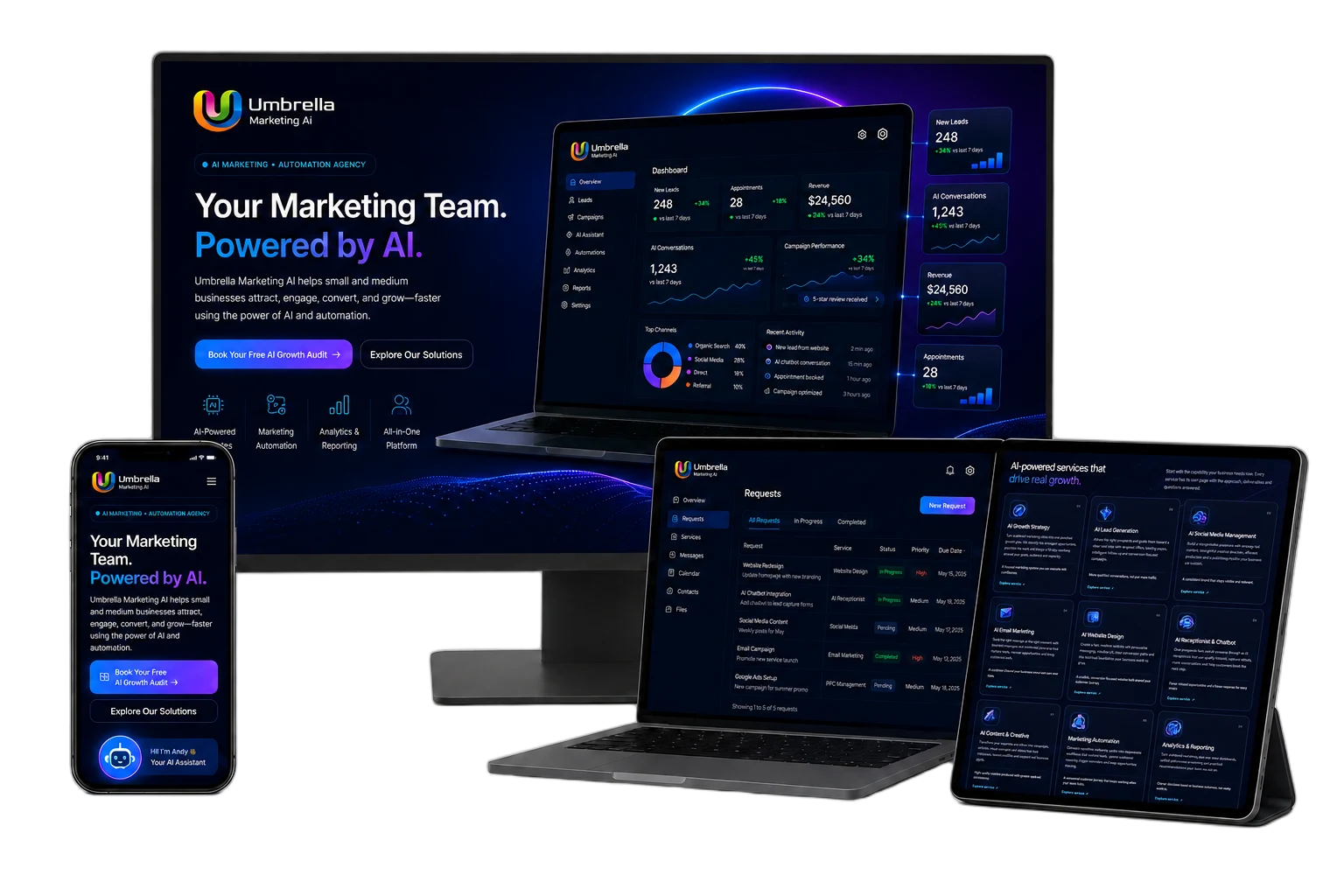
No metrics are claimed. These are future signals to track once the product has live traffic.
One system, delivered across the public site, the admin desk, and the client page.
Public website
One coherent brand and product system
Ten complete service journeys
One conversational guide
Admin AI Service Desk
One admin request and review workflow
Human approval before delivery
Recoverable versioned releases
Client service page
Responsive and search ready public pages
Future signals, not results. Each one is proposed, not promised.
Service page to request conversion
Proposed measure
Andy recommendation to service click
Proposed measure
Request completion time
Proposed measure
Human edit rate
Proposed measure
Approval rate
Proposed measure
Repeat request rate
Proposed measure
The dual role of UX/UI Designer and AI Product Manager prevented the public promise from becoming disconnected from fulfillment. Every service page I designed was checked against the downstream workflow. Every visual flourish was weighed against implementation time and maintenance cost.
Reusable patterns and governance rules were more valuable than custom solutions. The human approval gate was not a compromise. It was a trust feature that made the AI system credible.
— Monica · UX/UI Designer and AI Product Manager
Future research steps, not completed studies. They show what a rigorous validation plan looks like.
Moderated owner interviews
Validate the proto persona and journey map with real small business owners
Task based testing
Observe users navigating service selection, Andy guidance, and brief submission
Analytics instrumentation
Implement baseline tracking for proposed measures
Operations load testing
Stress test the approval workflow with simulated concurrent requests
Clarity beats volume
A smaller, clearer catalog outperforms a wall of options.
Patterns reduce complexity
Reusable structures let one team manage ten services.
Human governance is part of the experience
Approval is a trust feature, not a bottleneck.
Clarity, patterns, and human governance turned an AI promise into a credible, shippable experience.
One authoritative artifact captures the visual decisions across desktop and mobile.
Umbrella Marketing AI design system
The complete four page system documents the foundations, desktop components, mobile behavior, and icon family used throughout the product.
Umbrella Marketing AI Design System
PDF preview · 4 pages
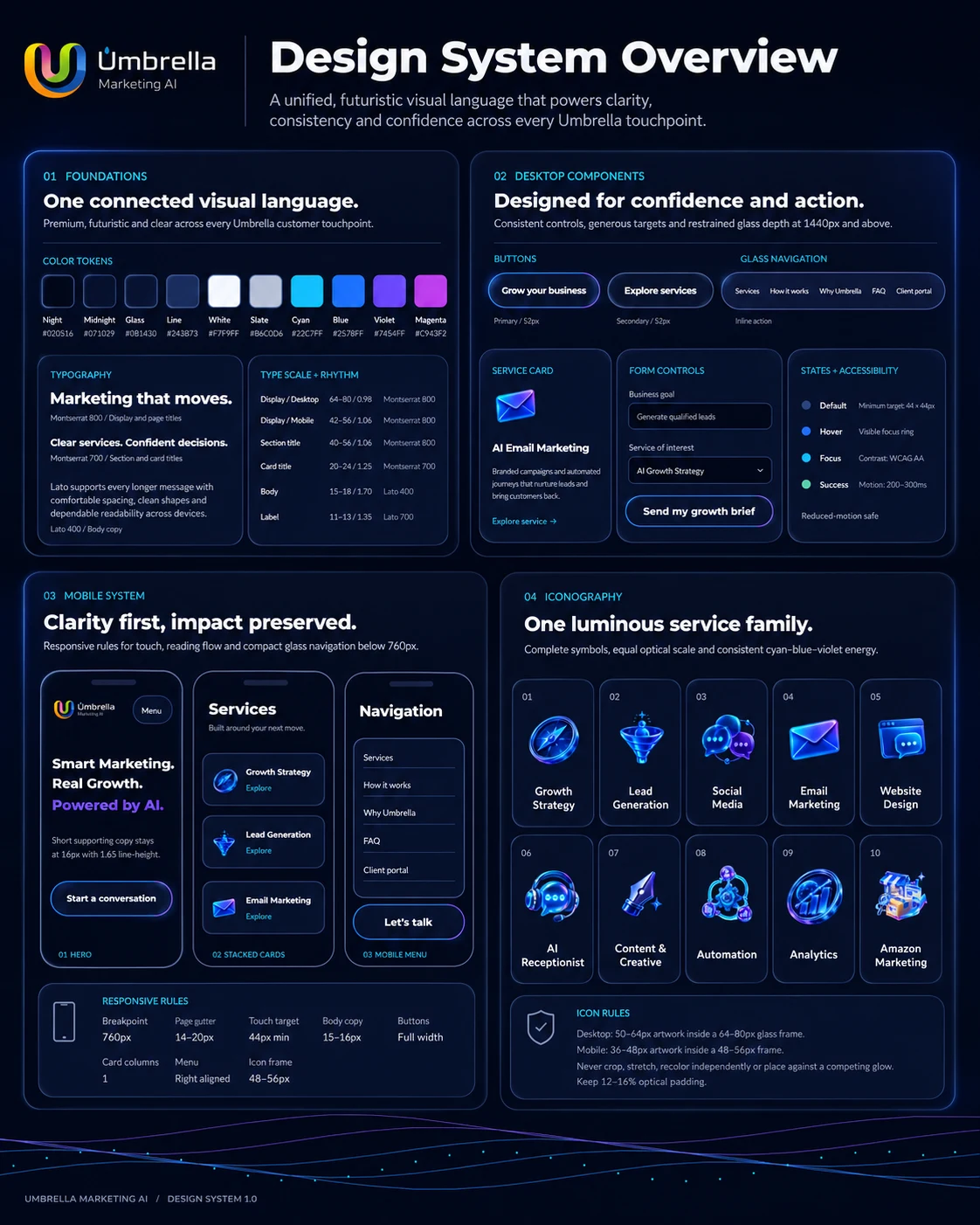
This is the project design system artifact used as the source of truth for color, typography, components, responsive behavior, and iconography.
If that approach fits what your team is building, I would love to talk.